 Rated Excellent on Trustpilot
Rated 4.9 / 5 from over 2,000 reviews on Etsy
Our exclusive Foil Fusion Technology™
Kits posted the next working day after you order
Rated Excellent on Trustpilot
Rated 4.9 / 5 from over 2,000 reviews on Etsy
Our exclusive Foil Fusion Technology™
Kits posted the next working day after you order
Rated Excellent on Trustpilot
Rated 4.9 / 5 from over 2,000 reviews on Etsy
Our exclusive Foil Fusion Technology™
Kits posted the next working day after you order
Rated Excellent on Trustpilot
Rated 4.9 / 5 from over 2,000 reviews on Etsy
Our exclusive Foil Fusion Technology™
Kits posted the next working day after you order

Comparison
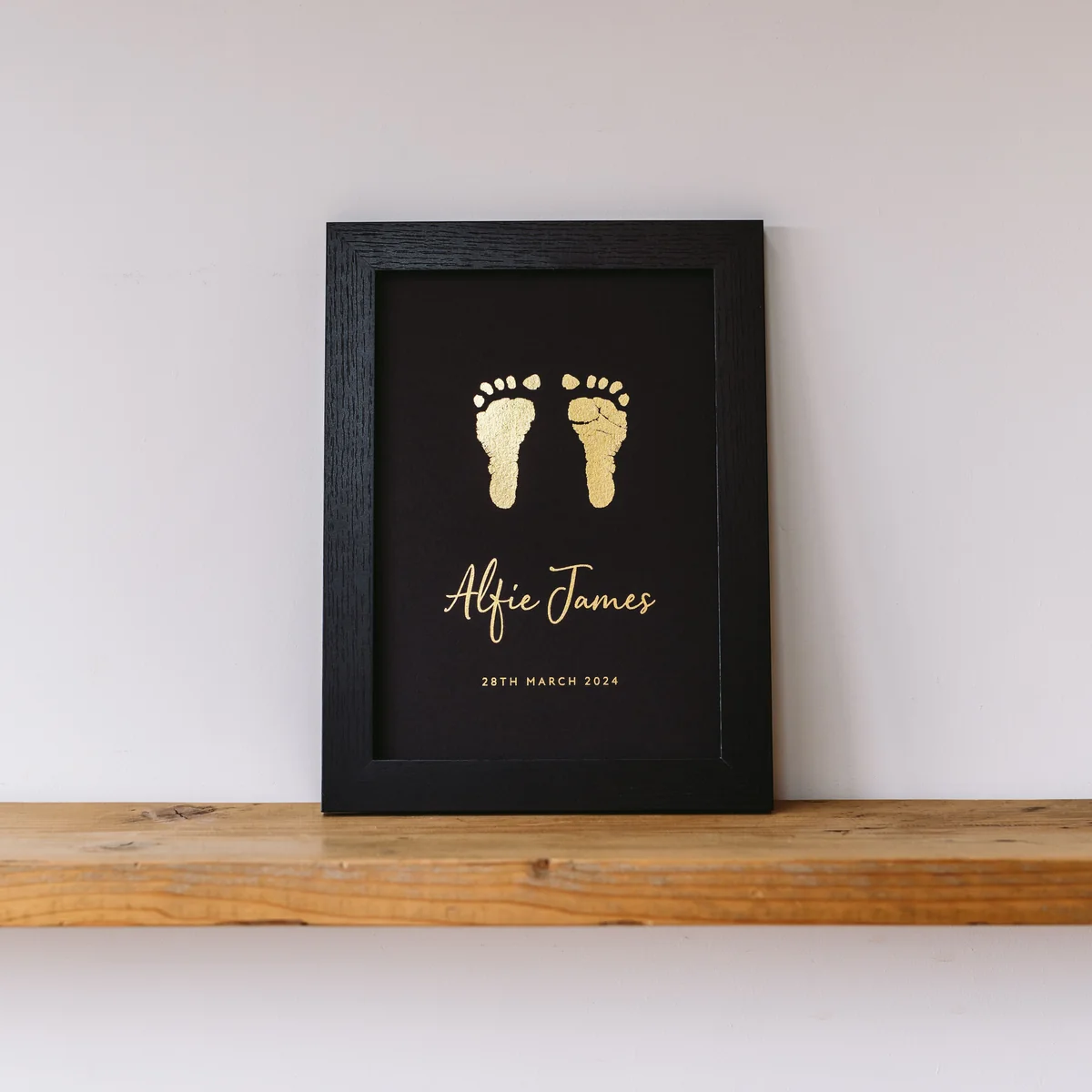
Four common ways to keep a baby’s handprint, compared on the things that actually decide it: mess, detail, how long it takes, and whether it still looks right in ten years. Clay and casting get talked about as the same thing and they are not, so they are separated out here. We make foil kits, so we have said plainly where the others are the better choice.
| Foil | Ink | |
|---|---|---|
| Mess | None. Inkless wipe, nothing visible on the skin | Ink on hands, needs washing off |
| Time with the baby | Under 5 minutes | Under 5 minutes |
| Finished same day | No, posted back to you | Yes |
| Detail captured | Fine ridges and creases | Good, varies with ink coverage |
| Works on a sleeping baby | Yes | Usually |
| Second attempt possible | Yes, multiple sheets included | Usually |
| Ages well | Foil is bonded to the card by our Foil Fusion Technology™, so no peel or fade | Ink can fade with light over years |
| If it is damaged later | We archive your artwork for as long as we are trading, so we can foil a replacement from the same prints | Nothing to work from unless you still have the original prints |
| Framed result | Yes, frame included | Usually paper only |
| Typical UK cost | £34.95 to £59.95 | £10 to £25 |
If you want something on the wall tonight, ink wins and nothing else comes close. It is also the cheapest way to try, which matters if you are capturing prints often rather than once. The trade-off is that ink sits on the surface of the paper, so strong daylight will lift it over a number of years, and you are washing a baby's hand afterwards.
Casting gets lumped in with clay, and the two are not the same thing. A clay kit gives you a pressed impression, a flat disc with the shape of the hand in relief. Casting gives you a three dimensional replica: the hand is dipped in alginate, a seaweed based moulding gel, the mould is then filled with plaster, and what you are left with is a small sculpture of the hand itself.
| Foil | Casting | |
|---|---|---|
| What you end up with | Framed print in real foil | 3D plaster replica of the hand |
| Mess | None, an inkless wipe | Alginate and plaster, both need clearing up |
| Time with the baby | Under 5 minutes | 10 to 20 minutes, held still throughout |
| Works on a sleeping baby | Yes | No, the hand has to be submerged |
| Newborn suitability | From day one | Difficult, curled fists cast poorly |
| Ready to display | Posted back finished and framed | Several days drying, then painting |
| If it goes wrong | Four sheets, so more than one attempt | Depends on spare alginate, the mould is single use |
| Ages well | Foil bonded to the card, no peel or fade | Durable, but chips and snaps if dropped |
| If it is damaged later | We archive your artwork for as long as we are trading, so we can foil a replacement from the same prints | Gone. The mould is destroyed in the making, so the cast is the only copy |
| Typical UK cost | £34.95 to £59.95 | £25 to £50 at home, more in a studio |
If that object is what you are after, nothing else on this page comes close and we will say so plainly. It is the only method here that gives you something with real volume, something you hold rather than look at.
The trade-offs are the steepest of the four, though. The hand has to stay submerged and still while the alginate sets, which is a couple of minutes of cooperation you are unlikely to get from a newborn, and a curled fist tends to trap the gel and take fingers off the cast when you demould it. The plaster then needs several days to dry fully before it can be painted or displayed. Home kits run around £25 to £50, and professional studio casting costs a good deal more.
| Foil | Clay imprint | |
|---|---|---|
| Mess | None. Inkless wipe, nothing visible on the skin | Dough on hands, needs washing off |
| Time with the baby | Under 5 minutes | 10 to 20 minutes, plus positioning |
| Finished same day | No, posted back to you | No, 24 to 72 hours drying |
| Detail captured | Fine ridges and creases | Shape and depth, not fine lines |
| Works on a sleeping baby | Yes | Rarely, needs pressure |
| Second attempt possible | Yes, multiple sheets included | Only before it sets |
| Ages well | Foil is bonded to the card by our Foil Fusion Technology™, so no peel or fade | Can crack or chip if knocked |
| If it is damaged later | We archive your artwork for as long as we are trading, so we can foil a replacement from the same prints | Gone. The tile is the only copy of itself |
| Framed result | Yes, frame included | Usually a standalone tile |
| Typical UK cost | £34.95 to £59.95 | £15 to £40 |
Clay is the only one of the three that gives you a physical impression you can run a thumb across, and for a lot of parents that texture is the whole point. It suits older babies who will hold still and tolerate the pressure. It is the hardest of the three with a newborn, because a curled fist will not press evenly, and there is no second attempt once it starts to set.
Foil suits the case most new parents are actually in: a very young baby, a curled hand, and no appetite for mess. The wipe is inkless, so nothing shows on the skin and there is nothing to wash off, and it can be done while the baby sleeps. You photograph the prints and upload them, and we post back the finished foil keepsake, so the trade-off is real: you wait rather than having something the same evening. In practice that is a digital proof within one working day of us receiving your prints, then despatch within five working days of you approving it.
You do not get it the same day. If the print is for a birthday tomorrow, buy an ink kit. Everything else about foil is a deliberate trade in favour of the finished object rather than the speed of getting one.
All three can be, but check what touches the skin. Our inkless wipes are non-toxic, hypoallergenic and free of dyes, pigments, alcohol and parabens, and are dermatologically tested. With ink kits, look for a specific non-toxic and washable claim rather than assuming. With clay, the concern is less the material and more the pressure needed on a very small hand.
Foil, because the foil is bonded to the card rather than printed on top of it, so there is nothing to peel or fade. Ink is next, and will hold for years out of direct sunlight. Clay lasts indefinitely if it is never dropped, which is the catch: it is the only one of the three that can be destroyed in a second.
This is the part nobody thinks about until it matters, and it is the one real difference between these four that has nothing to do with how the keepsake looks. A clay tile knocked off a shelf is gone, a plaster cast dropped on a tiled floor is gone, and neither can be remade, because the mould was destroyed in the making and the hands that made it are bigger now. You cannot go back and have that afternoon again.
Foil is the only one of the four where that is recoverable. We archive your artwork for as long as we are trading, so if a frame gets broken or a print is damaged in a house move, get in touch and we can foil a replacement from the same prints rather than asking you to start over with a baby who is now a toddler. We have kept every print since we started in 2017, including the very first one.
We are not claiming the others are careless about it. There is simply nothing for them to work from, because a clay tile is the only copy of itself and an ink print fades on the one sheet it lives on. That is worth weighing up front rather than finding out later.
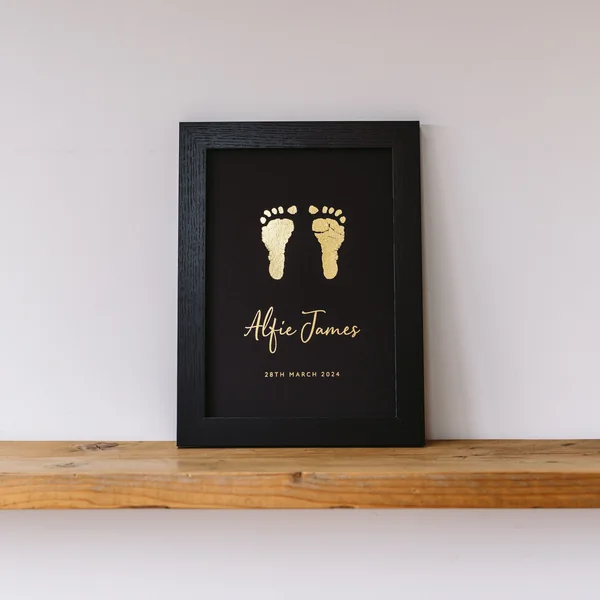
Our kit is £34.95 for the print-only version and £49.95 framed, with inkless wipes, four sheets so you get more than one attempt, and the finished keepsake posted back to you. The £59.95 Premium Kit adds gift boxing and keepsake finishing touches, which is the top of the range in the tables above. £1 from every kit goes to Tommy’s, the UK’s pregnancy and baby loss research charity.
Rated 4.9 out of 5 from 90 reviews on Trustpilot.
We’re new to Trustpilot, but not here: rated 4.9 / 5 from over 2,000 reviews on Etsy since 2018.